
The diversification illusion
Why “balanced” portfolios may be more exposed than they appear
Diversification is one of investing’s oldest principles—and, arguably, one of its most misunderstood.
Most client portfolios today appear well diversified. They span regions, sectors, and often include multiple managers and strategies. On the surface, they look balanced.
But appearances can be misleading.
Look beneath the labels, and many portfolios are still driven by a relatively narrow set of underlying forces. That distinction—between how a portfolio looks and how it behaves—has become increasingly important.
When diversification fails, it tends to fail together
At its core, diversification is straightforward: combine exposures that behave differently, so that when one part of a portfolio struggles, another can help offset it.
In practice, that’s becoming harder to achieve.
Global equity indices—now widely used as portfolio building blocks—have become increasingly concentrated. A significant portion of market capitalisation sits in a small group of US mega-cap companies, with a strong bias towards growth and technology.
By the end of 2025, the US made up roughly two-thirds of the MSCI All Country World Index, with the so-called AI-Eight (Nvidia, Microsoft, Amazon, Meta, Broadcom, Alphabet, Oracle and Palantir), alone representing close to 18.5% of the index. Other indices, such as the MSCI World or FTSE World Index, are even more concentrated.
But that concentration isn’t always obvious in portfolios.
An investor may hold hundreds of securities through index funds and still find that outcomes are largely driven by the same factors: US growth, large-cap technology, and momentum.
The result is a portfolio that looks diversified but behaves more like a concentrated exposure.
The risk of unconscious concentration
Importantly, this is not typically a deliberate decision. It is structural.
Passive investing allocates capital in proportion to market size. As companies perform well, their weights increase, which further amplifies their influence on portfolio outcomes.
Over time, portfolios can become heavily exposed to a narrow part of the market—without any explicit intention to do so.
That would be less concerning if valuations were unremarkable. But today, much of this concentration sits in areas where valuations are elevated by historical standards.
Across a range of long-term measures, global equities are trading at levels that have, in the past, been associated with more modest forward returns.
In other words, portfolios may be most exposed at precisely the point they feel most comfortable.
Diversification in form versus diversification in function
For advisers, the key question is not how many holdings are in a portfolio, but how those holdings behave.
Owning multiple funds or strategies does not necessarily result in diversification if they are driven by the same underlying factors.
True diversification is about behaviour.
It involves combining exposures that respond differently to changes in economic conditions, market regimes, and investor sentiment—across geographies, sectors, currencies, and investment styles.
Without that, diversification can become largely cosmetic.
This distinction tends to matter most when conditions change. When leadership narrows—or begins to reverse—portfolios built on the same drivers often move together.
For advisers, this raises a practical consideration: diversification should be assessed not just by allocation, but by underlying drivers of return.
Looking beyond the obvious
Where, then, can genuine diversification be found?
Part of the answer may lie in looking beyond the areas that have performed best in recent years.
Non-US markets, for example, currently trade at more modest valuations relative to the US. While US shares trade on average at around 38 times earnings, developed markets ex-US and emerging markets change hands at roughly 20 and 16 times respectively. In many cases, they offer exposure to businesses with sound fundamentals that have simply fallen out of favour.
Balancing investment styles can also help. Growth has led markets for much of the past decade, but leadership between growth and value has historically moved in cycles.
Value-oriented opportunities, while less prominent in recent years, may provide differentiated outcomes if conditions shift.
Currencies are another, often overlooked, dimension. Exposure beyond the US dollar can introduce an additional source of return, which may behave differently from underlying equity markets.
Taken together, these exposures can broaden the drivers of return within a portfolio—but only if they are introduced deliberately rather than by default.
The role of active decisions
None of this suggests that passive investing has no role to play.
But it does highlight its limitations in the context of diversification.
Index strategies, by design, reflect the market as it exists today. They do not adjust for concentration or valuation risk.
Introducing deliberate, valuation-aware exposures—whether through active strategies or targeted allocations—can help broaden the drivers of return and reduce reliance on a single market narrative.
The key is not activity for its own sake, but intentional differentiation.
For advisers, the challenge is not simply to build portfolios that appear diversified, but to ensure they are.
Because diversification is not about owning more.
It is about owning differently.
And in practice, that difference tends to matter most when it is tested. Explore how valuation-driven investing can improve portfolio diversification and resilience in today’s concentrated markets in our latest white paper.
Heres a preview of the White Paper below
Unconscious concentration Today’s global equity indices illustrate the problem. The MSCI All Country World Index (MSCI ACWI) is typically considered one of the most diversified major global equity indices—yet it too suffers from concentration. As at 31 December 2025, roughly 64% of the MSCI ACWI was allocated to the US. Mega-cap stocks made up 76% of the index, and information technology and communication services companies combined accounted for well over a third. A small group of stocks, the so-called “AI Eight” (Nvidia, Microsoft, Amazon, Meta, Broadcom, Alphabet, Oracle and Palantir), alone represent close to 18.5% of the MSCI ACWI. Other indices, such as the MSCI World or FTSE World Index, are even more concentrated.
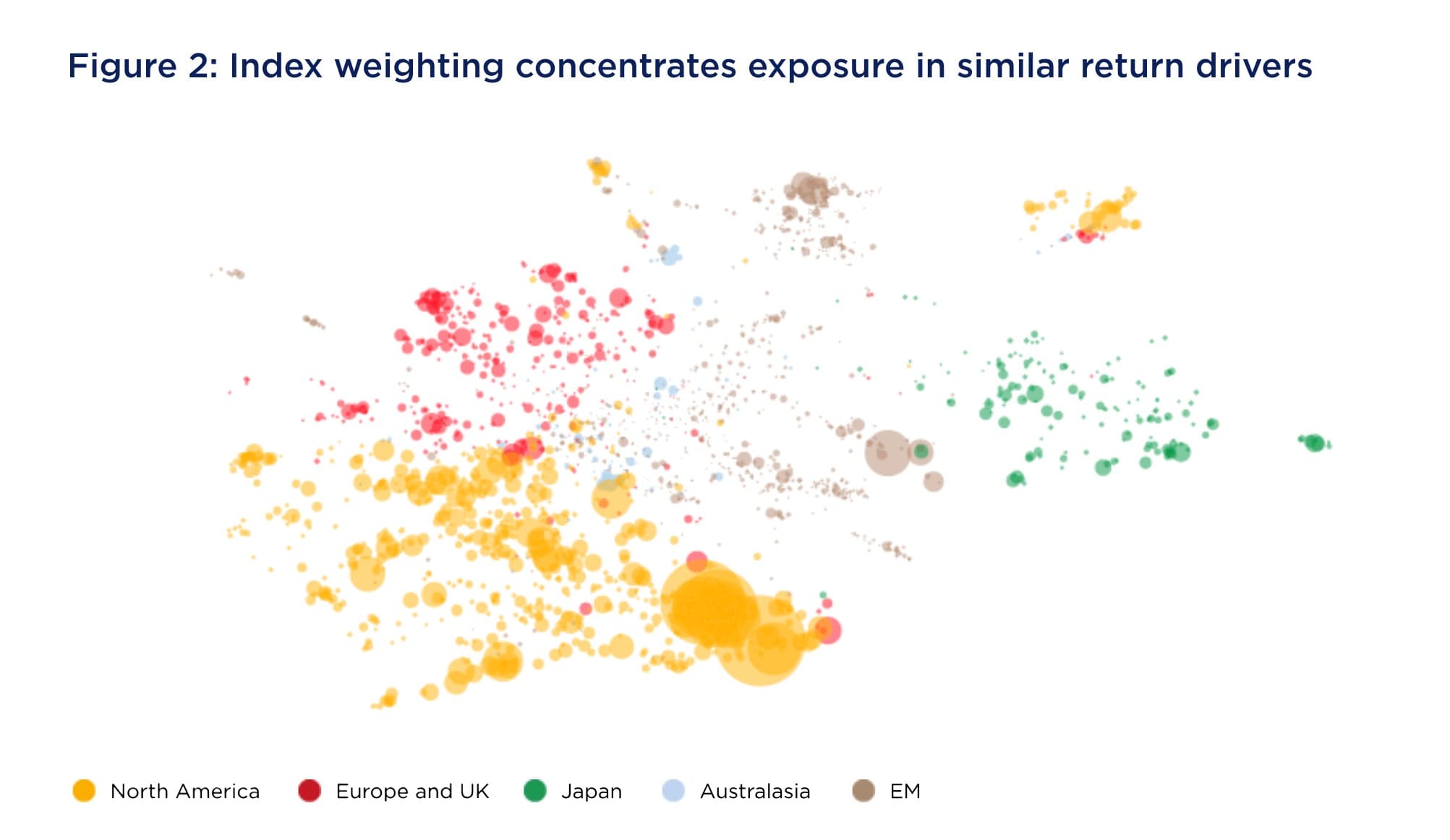
Statistics are compiled from an internal research database and are subject to subsequent revision due to changes in methodology or data cleaning. Global equity market depiction based on Uniform Manifold Approximation and Projection (UMAP) of 3-year weekly local equity returns. The area of the circles represents the relative weight of each stock in the MSCI All Country World Index (ACWI). The distance between dots captures the degree of co-movement between individual stocks. Stocks exhibiting a high degree of co-movement are clustered together.
Figure 2 brings this to life. This chart now scales each dot by its index weight. When compared with the previous chart, the result is telling: large, US-based stocks dominate the picture, and many of them sit close together, reflecting their shared drivers and high correlation. Despite the index owning many names, its risks are clustered in a few, expensive areas. A seemingly “global” portfolio, in other words, can amount to a concentrated bet on one country, one sector, and one investment style—while other areas are ignored or underrepresented.
This concentration is often not deliberate, but structural. Passive index investing hard-wires yesterday’s winners into tomorrow’s portfolios. As those winners grow, they become larger weights, which amplifies momentum on the way up and risk on the way down. The illusion of diversification is that you feel safe precisely when you’re most exposed.
Past performance is not a reliable indicator of future results. This constitutes general information only and is not personal financial product, tax, legal, or investment advice, and does not take into account the specific investment objectives, financial situation or individual needs. It is not a recommendation to buy any particular security or adopt any investment strategy. This represents Orbis’ view at a point in time and provides reasoning or rationale on why we bought or sold a particular security for the Orbis Funds. We may take the opposite view/position from that stated, as facts or circumstances change.
See Ensombl first in Google News results for financial advice.